

Build A Better Breakfast
Your Foundation for Optimal Daily Health

Note to readers: You can listen to this article by clicking on the voiceover recording above.
“Eat breakfast like a king, lunch like a prince, and dinner like a pauper.”
– Dr. Mark Hyman 1
Several years ago I taught a two-week nutrition program at a local middle school. Four of the six classes I visited took place in the morning. The students slouched in their seats, fiddling with their sweatshirt sleeves. Few of these 8th graders were interested in nutrition, and when I asked the class questions, they looked at me as if gazing through a fog, if they looked up at all.
Except for one student, Jake, who sat up straight, paid attention, and raised his hand when I asked the class, “How many of you ate protein for breakfast this morning?” No other hands went up. Clear-eyed and intelligent, Jake said he’d been eating scrambled eggs for breakfast lately, sometimes in an omelette with veggies.
“Why just lately?” I asked.
Jake shrugged. “I guess I wanted to experiment and see how it would affect me,” he replied.
This was music to my ears. “Excellent!” I replied – for curiosity is the best motivator for making dietary changes. It’s also the result of a good breakfast, for an inquisitive mind requires good fuel and a steady metabolism. By starting his day with a nutrient-dense breakfast, that’s precisely what Jake provided for his growing body and brain. What better way to enable his attention span, improve his academic achievement, and reach his athletic goals?
The same is true for grown-ups, though many people don’t know how to eat in a way that serves their health. “What should I eat for breakfast?” is one of the most frequent questions I get as a health coach. And it’s a good one, for how you break your fast each morning builds the foundation for your metabolic health all day long, and beyond. But as busy adults, we must balance our nutritional needs with our demanding schedules, often grabbing food on the go. How can we start our day right, and what choices will best serve our needs?
To answer this question, we can start by turning the clock back two centuries, before the invention of breakfast cereals, smoothies, energy bars, and protein shakes. In the northern states of our newly-formed nation, people commonly ate baked beans, eggs, whole grain porridge, and salted fish. In the South, breakfast might have been eggs, corn grits, ham, rice, or sometimes sweet potatoes. Upper class families might have enjoyed steak, chops, fresh brown bread, coffee, or chocolate. On the frontier, meals depended heavily on whatever could be hunted, preserved, or grown locally. Fresh fruit was only available in season. Refrigeration didn’t exist. Neither did processed or manufactured foods.
In other words, breakfast was a savory meal – often the biggest meal of the day, because people were heading into hours of physical labor. By contrast, many Americans today have sedentary jobs in front of computer screens, and either skip breakfast completely or only have coffee with sweetener, a pastry or muffin, cereal or granola, and perhaps some fruit. Our largest meal of the day is typically supper, which is consumed after the activities of the day are behind us. Is this progress?
Let’s explore the basic principles behind a healthy breakfast. Two major factors come into play: circadian rhythms and insulin.
Circadian Rhythms: Your Biological Clock
Circadian rhythms refer to the body’s natural internal 24-hour cycle that regulates functions such as sleep and wakefulness, hormone release, body temperature, cellular repair, digestion, detoxification, and many other biological processes. These rhythms are controlled by “clock genes” in the hypothalamus section of the brain that respond to darkness and light, interacting in intricate feedback loops that build up during the day and then suppress their own production at night. This core mechanism or “biological clock” affects everything from immunity to body weight to mental health. Its discovery just nine years ago (in 2017) won the Nobel Prize in Physiology and Medicine2 – rightly so, for it has transformed our understanding of biology.
Our daily rhythms are genetically built into our cells. In addition, many organs have their own local molecular clocks that coordinate timing for their functions – especially the pancreas, liver, stomach, and thyroid. Any internal misalignment may contribute to many of the chronic diseases associated with modern lifestyles: insulin resistance, type 2 diabetes, obesity, fatty liver disease, acid reflux, hypertension, increased risk of blood clots, thyroid disorders, poor sleep, depression, cardiovascular disease, gastrointestinal disorders, and some cancers. Even the efficacy of vaccines may be affected by your biological clock. This field of scientific inquiry – known as “chrononutrition” – is evolving rapidly, exploring how meal timing, artificial light, and shift work affect organ-specific clocks over long periods. Modern circadian biology increasingly views the body as a network of synchronized clocks rather than one central timer.
Our foremothers and forefathers did not have electricity, and therefore rose with the sun and lived by candlelight after dark. They had no choice but to align the rhythm of their days with those of nature. We descendants do have a choice, often to our detriment – but with a little understanding, we can make better choices.
We are fortunate to have agency over the food we eat to break our morning fast, and the timing of our meals throughout the day. Breakfast lays the foundation for your metabolic functioning. Day by day, your personal eating pattern sets a precedent for your pancreas. By eating the right foods, you can establish and maintain insulin sensitivity, which is greatest in the morning and diminishes throughout the day. Exercise also boosts insulin sensitivity.
Why does insulin sensitivity matter? I can hardly think of anything that matters more, for your body’s ability to burn fuel and create energy depends on it. Glucose, whether coming directly from food or broken down in the liver from stored fat, is what powers every cell in your body. When insulin receptors begin to resist insulin, glucose is no longer taken up efficiently. Circulating glucose wreaks havoc by sticking to proteins (this is what is measured in the hemoglobin A1C blood test), while unused insulin breaks down into free radicals, causing oxidative stress and chronic inflammation throughout your body. These are the driving forces of chronic disease, as well as aging itself – known as “inflammaging” in functional medicine circles. Insulin also governs fat storage, weight gain, and the rise and fall of melatonin, which is necessary for sleep, as well as cortisol, which wakes you up. Excess cortisol may be both the cause and the result of too much stress, and is known to shrink the hippocampus, the memory center of the brain. For all these reasons and more, insulin sensitivity is one of your most precious assets for preventing inflammatory disease, maintaining a functional metabolism, and supporting healthy aging.
Eating a low-carb, high-protein breakfast minimizes the need for insulin and keeps its secretion within a safe range, avoiding the spikes that overwhelm your insulin receptors. Less insulin at your first meal helps to lower your baseline for the rest of the day, preserving insulin sensitivity and reducing inflammation. You can experiment yourself and feel the difference! Protein also builds muscle and connective tissue, supports immunity, and helps maintain optimal body weight.
“There’s something magical called the thermogenic effect of protein, which means you actually burn more calories when you consume protein. So about 30% of the calories get used in actually just metabolizing the protein.”
– Dr. Mark Hyman3
Healthy fats and sufficient fiber are also important. Fat provides steady fuel, whereas refined carbs such as breakfast cereals and shakes burn out quickly, like small kindling as opposed to a thick log that burns all day. Fiber sets the rate of digestion, slowing it down and along with it, the rate of insulin secretion. Your goal is at least 30 grams of fiber per day; half of that should be consumed at breakfast, if not more.
This is the rhythm of your body. You can either harmonize with it and flow with the current, or impede its natural flow – a losing proposition.
Some key concepts to keep in mind:
A larger, protein-rich breakfast may help stabilize blood sugar, energy, mood, and appetite.
Eating heavily at dinner may be less favorable metabolically.
Some studies found people burned more calories processing the same meal when it was eaten at breakfast instead of dinner.
Time-Restricted Eating
Nutrition and health media are abuzz with many perspectives on intermittent fasting, now more commonly known as time-restricted eating. Allowing your digestive organs a complete break while you sleep is critical for repair and detoxification, especially in the liver. The ideal for women is 12-14 hours of fasting (nothing but herb tea, water, or salt water) between dinner and breakfast, or 14-16 hours for men. Delaying breakfast is okay; skipping it completely is not recommended, except in the context of an occasional, more prolonged and deliberate fast.
So what’s a good breakfast?
The Pro’s and Con’s of Smoothies
Many people drink smoothies for breakfast, which may be rich in fiber from fruits and veggies. However, consider the impact of breaking down the fiber with a high-speed blender, as opposed to chewing foods in their whole form. While the chemical fiber content remains the same either way, your body processes the two forms differently. On the positive side, blending may partially break plant cell walls, making certain nutrients easier to absorb. But smoothies pass through your stomach faster than whole foods, and puréed fiber may absorb faster, causing a quicker blood sugar rise. By contrast, whole foods require chewing, which triggers hormones that make you feel fuller. Swallowing your breakfast without chewing also bypasses your salivary glands, denying them their crucial role in digestion: to begin breaking down carbohydrates with amylase, and even more important, to signal the pancreas about what to expect and how to calibrate insulin.
In addition, chewing the fiber in vegetables, fruits, nuts, and seeds also stimulates the bacteria on your tongue to produce nitric oxide, a gaseous signaling molecule that dilates blood vessels, controls blood pressure, and acts as a key antioxidant in neutralizing toxins and repairing cellular damage from inflammation. Nitric oxide is made from the nitrates in vegetables such as arugula, beets, spinach, bok choy, and parsley. Find a list of nitrate-rich foods here. Swallowing these foods without chewing denies your body an important asset – like trying to build a house on a weak or partial foundation. In addition, raw cruciferous vegetables such as kale – a popular smoothie ingredient – are poorly absorbed, and contain unwanted goitrogens (naturally occurring compounds that can interfere with normal thyroid function by blocking your body’s ability to use iodine). It’s better to steam or marinate your kale before eating it.
As for protein powders, please see my article “Prioritize Your Proteins” for more on this subject.
What About Bananas?
America’s love affair with bananas began in 1870, when this tropical fruit was first imported from Jamaica to Boston. At first, people did not know what to do with them, and even tried to eat the peels. Marketed as an exotic delicacy, bananas quickly became popular, and the industry grew rapidly through companies that later became giants like United Fruit Company (now Chiquita Brands International) and Dole. Today, the U.S. banana import market is worth roughly $2.4–$3.2 billion annually. Recent trade data shows the U.S. imported about 10.4 billion pounds of bananas in 2024.4
But are bananas healthy? With a glycemic index of 50-65 (depending on ripeness), their high sugar content is sure to spike your blood glucose, fructose, and sucrose. The resistant starch of a green banana helps to mitigate this effect, but this only reduces the damage. Pairing a banana with protein and fat (such as yogurt, nuts, or nut butter) may further blunt blood sugar spikes – but if your goal is to lower your insulin, reduce inflammation, and prevent or reverse cognitive decline or chronic disease, why eat such a sugary fruit for breakfast – or at all? Yes, bananas contain potassium – and so do numerous other foods, including avocado, which makes a smoothie just as creamy with healthy fat, a glycemic index of 12-15, and because of its high fiber content, just 2-4 grams of net carbohydrates. That’s a lot less than 50-65 grams.
The Cost of Convenience
“But I don’t have time to sit and eat all the foods I put in my smoothie.”
Perhaps even more than sugar or coffee, Americans are addicted to convenience. Breakfast on the go has long been marketed as a smart choice, with all kinds of drive-through delis, cafés, and fast food joints offering a quick pick-up. Is it really unthinkable to take the time to chew your breakfast rather than liquifying it and gulping it down? We make time to shower or meditate in the morning, to listen to the news or read the morning paper, but breakfast as a morning ritual has fallen out of style.
The way I see it, good health is the greatest time-saver, both now and in the future. How much time do you want to spend in doctors’ and dentists’ offices as you age? Would you rather spend your money on high-quality food now or prescription co-pays later? What side effects of ongoing medications and treatments are you willing to accept? Your choices today will determine your downstream health – or as the saying goes, “Pay the farmer now or the pharmacy later.”
A Better Breakfast Template
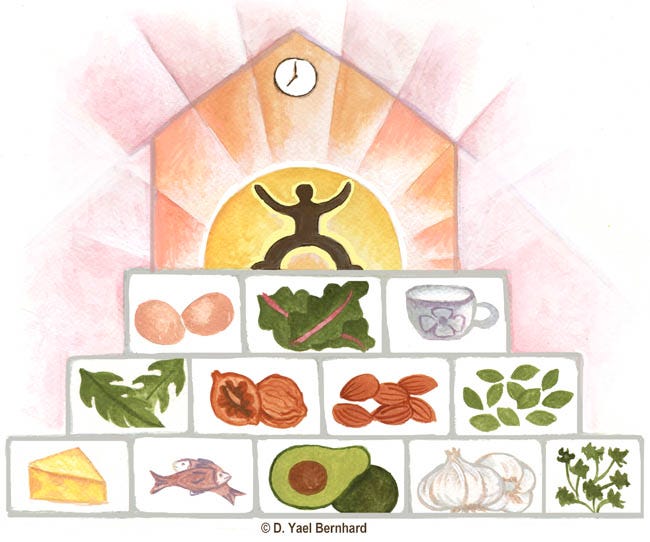
For me, a typical breakfast consists of a frittata made with onions and cruciferous veggies. One pan of frittata typically lasts four days, with each serving comprising two or three eggs, topped with raw garlic and MCT oil. Along with this, I eat a salad, usually with arugula, avocado, and if possible, fresh dandelion greens that I pick while taking my dog on her morning walk. Leftover salad from the night before will also do, topped with olive oil and fresh lemon juice or herbal vinegar. I also add some wild-caught mackerel, sardines, or canned salmon, a piece of cheese, several Brazil and macadamia nuts, two pieces of unsweetened chocolate, two handfuls of pumpkin seeds, and a large cup of nourishing herbal infusion with liquid mushroom extracts.
This nutrient-dense breakfast contains approximately 50 to 60 grams of protein (more than half my daily intake), 14 to 17 grams of fiber, and 26 to 34 grams of carbohydrates (or roughly 12 to 17 grams of net carbohydrates, as the fiber level reduces their impact). Sometimes it’s my biggest meal of the day, and it keeps my energy flowing steadily. I wake up easily, and rarely feel tired before it’s time to go to sleep. And although my breakfast contains over 1300 calories, my body weight remains optimal with no effort on my part to keep it down. Here’s why:
“Thermogenesis – the heat and calories that are burned just by the process of metabolizing your food – is two and a half times higher when the high calorie meal is consumed in the morning . . . . So you basically burn two and a half times more energy at breakfast compared to the same meal at dinner. A low calorie breakfast also induces cravings for carbs and sugar throughout the day. Why? Well, it has to do with our circadian rhythms, which prime our body to be more efficient at digesting, absorbing, and metabolizing food early in the day . . . . It’s like putting gas in the beginning of a car trip rather than at the end of the trip.”5
– Dr. Mark Hyman
Within this basic breakfast framework, I constantly vary the ingredients. I buy different eggs – pasture-raised chicken, duck, and pheasant eggs – from several local farms, where the birds in each place graze on plants and insects from a unique soil-food web. Phytonutrients from these plants, protein and fat from insects, and soil-based probiotics and fungi all translate into the quality and variety of nutrients in the eggs. I use many kinds of onions, from white to yellow to red, or rotate in wild or store-bought leeks, scallions, or shallots. I use different cruciferous veggies, mixing kale and collards, brussel sprouts and broccoli, or whatever is on hand. I keep red cabbage in the house because it keeps a long time, and adds precious anthocyanins from its beautiful purple color. If I run out of other choices, I always have that on hand. Sometimes I add mushrooms to the mix. I also vary the type of oil I use: coconut, avocado, beef tallow, and grass-fed butter are my usual choices. And I reach for different spices to jazz up my breakfast – rosemary, thyme, herbs de province, and curry are my favorites – and sometimes I add goat or sheep cheese on top. Even within a regular habit, there’s room for variation.
Why all this deliberate diversity? Because fiber feeds gut bacteria, and plant-based foods are rich in beneficial phytonutrients. Cruciferous veggies, for example, contain sulforaphanes, which are known to both fight cancer and help neutralize and eliminate the toxins in microplastics.6 I want cruciferous veggies in my diet every day, and breakfast is an easy way to do that. (I often eat them with dinner, too.) Fibrous vegetables and mushrooms also provide the substrate that your beneficial gut bacteria ferment into short-chain fatty acids – postbiotic metabolites that energize your intestinal lining, protect your blood-brain barrier, and offer so many benefits, I shall have to write an entire article on this fascinating subject. These are the building blocks of your microbiome, and the more diverse, the better your gut, your brain, your skin, and your immune system.
Leftover dinner or soup are also good options for breakfast, as is whole, unsweetened yogurt with nuts, seeds, and berries. These foods are likely to be higher in carbs, however (yogurt contains lactose, berries contain fructose, and soups and dinners often include starchy vegetables, pasta, or grains). I try not to break my fast with carbs unless I plan to exercise immediately afterwards – for exercise not only opens up your insulin receptors, but stimulates the production of nitric oxide and increases your insulin sensitivity for several hours afterward. It’s not hard to do – I just take my dog for a walk, do chores that are physically active, or head for the gym before I start the rest of my day.
Cereal, Granola, and Oats
Packaged breakfast cereals began to be mass manufactured in the United States in the late 1800s. The U.S. breakfast cereal and granola market is currently estimated at roughly $13.5–$23 billion annually. These popular, ultra-processed foods are nearly devoid of all nutrition, which is why they’re artificially fortified – a poor substitute at best. Dry cereal is extruded from refined grains that have been processed to the point of destroying their fiber. These foods are essentially dessert disguised as breakfast, with refined carbohydrates that break down directly into sugar in your digestive system, causing insulin spikes and inflammation.
Oatmeal, while a little better by comparison, is a high-glycemic grain – not an ideal way to start your day. Adding nuts, seeds, butter or coconut oil mitigates the problem to a degree, but for anyone with high fasting insulin or blood sugar (that is, 50% of the American population), it’s best to skip this glucose-spiking grain. Oat milk is even worse, with a glycemic index higher than sugar itself due to its complete lack of fiber and high level of maltose (grain sugar). If you must eat oats, choose steel-cut oats, which have a lower glycemic index due to the fiber being cross-cut rather than crushed (that is, “rolled”). Like most foods that cook slowly and digest slowly, steel-cut oats are a healthier choice.

Let’s leave these carbs aside and remember the bigger picture: the goal is to eat a savory, nutrient-dense breakfast, composed of protein, fat, and fiber, with as many phytonutrients as possible from a variety of plant-based foods, herbs, spices, and teas. Diversity is key. If you’re a coffee drinker, consider switching that out sometimes for a different brand, or a different beverage, such as hot cocoa or a brew made from chicory root, dandelion root, or mushroom powder. If you’re a tea drinker, try different kinds – black, white, green, oolong, jasmine, sencha, kukicha, and ginger are just a few examples. My very first beverage each morning is a glass of water with fresh lemon juice and mineral-rich salt (which I also vary). This immediately boosts my electrolytes, further stabilizing my energy and mood for the day. Along with my breakfast I drink nourishing herbal infusions (see my article Infuse Yourself With Liquid Nourishment for more on this subject).
We tend to consider only what ingredients are in the food we eat, but when we eat and how our food is processed and absorbed are just as important. All comprise the bricks and stones of a strong and healthy foundation. Understanding your bodily rhythms as part of the larger rhythms of the sun, moon, and stars is both comforting and sustaining, and enables you to harmonize with the energy and cycles of life. It feels good to align with those rhythms and feel part of the natural world you live in. What better way to make music with your metabolism?
To your good health –
Yael Bernhard
Certified Integrative Health & Nutrition Coach

Yael Bernhard is a writer, illustrator, book designer and fine art painter with a lifelong passion for nutrition and herbal medicine. She was certified by Duke University as an Integrative Health Coach in 2021 and by Cornell University in Nutrition & Healthy Living in 2022. For information about private health coaching or nutrition programs for schools, please respond directly to this newsletter, or email dyaelbernhard@protonmail.com. Visit her online gallery of illustration, fine art, and children’s books here.
Information in this newsletter is provided for educational – and inspirational – purposes only.
Have you seen my other Substack, Image of the Week? Each week devotes a short post to one illustration or work of fine art, and shares the story and creative process behind it.
https://drhyman.com/pages/best-breakfast-foods-to-supercharge-your-health-transcript
https://www.nobelprize.org/prizes/medicine/2017/advanced-information/
https://drhyman.com/pages/best-breakfast-foods-to-supercharge-your-health-transcript
Statistics from ChatGPT.
https://drhyman.com/pages/best-breakfast-foods-to-supercharge-your-health-transcript
https://www.foundmyfitness.com/episodes/excrete-microplastics-bpa-phthalates