

Mind Your Meat
The quest for quality of life for animals and better health for humans

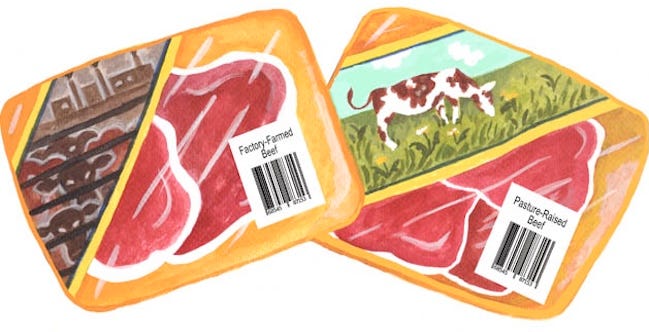
You are what you eat – and what your food eats. 1
It was a cool spring morning, and the muddy thaw was still soft underfoot on the way up the hill to the pasture. The land rose gently between low stone walls as old as the farm itself, built almost two hundred years ago by the Hubbell family in this beautiful mountain valley. The picturesque cluster of barns overlooks a winding creek that gathers snowmelt from the Catskill Mountains, feeding the headwaters of the Delaware River.
Remnants of last year’s plants were still visible in the cow pasture, pressed into the earth by snow and heavy hooves. Dandelion, chickweed, clover, plantain, chicory, and several grasses would soon grow again into forage for the four dozen cattle that graze here. Hubbells Farm is proud of their Scottish Highlanders, impressive animals with long hair in rusty hues, mottled beige, dark brown, and solid black. Both cows and bulls have wide horns, elegantly curved. They watched us now as we approached, their large eyes intent but peaceful.
The artist in me was more inclined to paint these beautiful bovines than write about them, but I was eager to learn the arc of their lives. My host, Kevin Hubbell, had grown up on this family farm and knew everything about it. He answered my questions patiently. The cows, chickens, and pigs living here are incredibly fortunate, dwelling at one end of a spectrum and living an idyllic existence. The cattle mate naturally, and spend their entire lives on pasture, including fields and woodlands. Since they’re raised for meat and not milk, the baby calves nurse until natural weaning age, and may stay with their mothers all their lives. A small portion of the herd is sent to slaughter each year, to a location less than an hour away. Until that day, these animals lead happy lives, forming “friendship groups,” grazing on wild plants and eating hay in winter. The number of cows culled each year is determined by the ability of the land to support the herd, which must be kept in proportion. “The herd lives in paddocks that are 2:1 (forest to pasture) all year long,” explained Hubbell, who also holds a degree in forestry. “They graze on grass and browse on low hanging leaves and small trees. This helps us thin our woods for firewood and maple syrup operations, and provides an alternative food source for our cattle.” Grazing patterns are rotated each year in a cycle that continually enriches the soil and benefits the forest – a technique known as “silvopasture” that integrates forest, fields, and livestock in a diverse and thriving ecosystem.
The meat from these animals creates an equally diverse and thriving internal ecosystem in those who consume it. Every plant the cows eat in the course of their lives, all the gifts of fermentation from their magical rumens, every mineral, microorganism and insect woven into their animal flesh yields an intricate consortium of nutrients. The fields and forests where these lucky beasts graze literally manifest through them. And we are the lucky omnivores who get to eat their meat – an honor and a blessing not to be taken for granted.
A profit-driven industry
At the other end of the spectrum are the factory-farmed animals who live a life of hell. I could never visit such a place, both for the trauma it would inflict on my nervous system, and because no facility would ever allow it. Transparency would quickly unravel the meat industry, for few people could suffer to witness it. Yet whether we see it or not, the effects of these tortured animals’ lives trickle down into our own bodies as precisely as the benefits of pasture-raised meat. Among the practices inflicted on these “animal commodities” are fake milk fed to calves; separation of calves from their mothers within hours of birth; confinement in crowded pens or tight cages; and complete lack of sunshine, fresh air, or normal movement. Their diet consists of chemical-laced grains (including glyphosate-treated corn and soy, corn gluten, cottonseed meal, and vegetable oils); animal fat (totally unnatural for herbivores); and discarded, rotting, or putrid foods (often fermented to reduce contamination with mycotoxins); sawdust; peanut hulls; corn cobs; citrus pulp, waste from processed junk food such as french fries; grains leftover from ethanol production; wood fiber fillers; surplus candy; bakery waste; and synthetic vitamins (which are poorly absorbed). The ill effects of this disgusting diet result in the overuse of both antibiotics and painkillers (which end up in our water systems). Other cruel practices include the handling of terrified animals with electric prods, and deplorable conditions in transporting them to slaughter, often a distance of hundreds of miles in hot, crowded trucks. Sick, infected, lame and elderly animals are also sent to slaughter, including “spent” dairy cows who, after a lifetime of forced lactation, are no longer productive. These inferior cuts are combined from many animals and used for ground beef, pet food, and by-products, the quality of which cannot be discerned by eye.
Mass-produced ground beef may easily be made more attractive and profitable with the use of various additives and extenders – none of which enhance this already-inferior, nutrient-deficient product of unmitigated misery. Unless the package says “100% ground beef,” it may contain any of the following: phosphates; synthetic binders such as bread crumbs, oat fiber or starches of unknown origin; soy protein isolate (to increase bulk); trimmings treated with ammonia (to kill bacteria); lactic or citric acid sprays; and carbon dioxide to help retain red color. Such additives are found mostly in beef patties, pre-formed or seasoned burgers, and burger mixes.
Even “100% ground beef” may legally contain extra fat trimmings, added to the lean meat because – well, a sedentary, grain-fattened animal doesn’t have much muscle. Adding extra fat increases volume, and – buyer beware – also raises the level of saturated fat. Such meats are transported long distances, and are therefore not as fresh or sanitary. 25 billion pounds of commercial beef are consumed annually in the U.S., leading to thousands of cases of E. coli or salmonella infections, with roughly 2000-3000 hospitalizations and 30-60 deaths per year.2 Severe, long-term after-effects may persist in survivors, including kidney failure, IBS, reactive arthritis, and thrombocytopenia (low blood platelets).
All this bad energy translates directly into the meat. Once packaged, factory-farmed products look the same as local, pasture-raised meat – but the difference between them is far bigger than the price – and unfortunately, we pay a high price later for eating poor quality food. You’ll surely save money by purchasing factory-farmed meat, but in addition to unwanted toxins and inflammatory compounds, what you won’t get are the healthy proteins and other nutrients found in pasture-raised meat. These include omega-3 essential fatty acids, necessary for human health (especially brain health); conjugated linoleic acid (CLA); retinol (the usable form of vitamin A); vitamin K; vitamin E; health-promoting phytonutrients such as terpenoids, phenols, carotenoids, and other anti-oxidants; and mineral and microbial content from soil.3 Pasture-raised meat is also richer in flavor and satiety.
Reducing harm, preserving health
It’s easy to understand why some people choose to give up meat entirely in response to the harsh realities of industrial farming. The fortunate few grass-fed animals who live out their lives on small farms represent only about 10% of the roughly 90 million beef cows in the United States. The other 85%-95% begin their lives on farms, but eventually enter the industrial feedlot system, where they are grain-fattened, slaughtered, and processed. In terms of approximate numbers, 850,000 beef farms of 50 animals or less feed their cows into a few thousand large feedlots, which turn the animals over to just a handful of huge processing centers. It’s a hybrid system that is decentralized in the beginning and highly industrialized in the end.4
Dairy cows arguably suffer even more than cows, pigs, and chickens raised for meat, and bring other considerations – a subject to be explored in a future article.
If I thought it were possible to be healthy without eating meat, I’d give it up in a heartbeat, for my heart truly goes out to the suffering of animals. The more I research the subject, however, the more compelling evidence I find that animal fat and protein are crucial for human health (see my articles The Plant-Based Puzzle and Vetting the Vegan Diet). Therefore, to minimize animal suffering I do not buy factory-farmed meat, rarely eat meat in restaurants (rarely = maybe once a year), and restrict my purchases to high-quality, mostly local, pasture-raised or grass-fed meat and dairy. Yes, I pay more, but I’m also supporting small farms that treat animals right, and I get what I pay for: quality nutrition and all its health-enhancing downstream effects.
It’s common sense that just as the physical substance of our bodies is made of the food we eat, so too are the flesh, blood, and bones of the animals we eat. The same is true of plants consumed by people – their phytonutrients come from the soil they grow in, and the mycelium, microorganisms, and minerals found within. Whether plant or animal, where our food grows and what it lives on shows up on our plate, and once digested, shapes every aspect of our health.
But when we see the price of organic, grass-fed meat on the supermarket shelf, it’s often just too much. Why spend $19 for an organic chicken when you can get a whole bird for $8.50? According to AI, the price of organic chicken is 47%-100% higher than its factory-farmed counterpart. For many shoppers, this difference is just too much. After all, the two chickens look alike on the shelf, and might not taste that different, depending on how they’re prepared. The same is true of red meat, pork, turkey, lamb, dairy products, and eggs – whether factory-farmed or pasture-raised, the end product looks the same.
But truly, looks can be deceptive. Research shows the composition of muscle in grass-fed animals resembles that of a healthy human athlete; while that of grain-fed animals exhibits metabolic health issues, both from diet and lack of exercise.5 This is similar to comparing active to sedentary humans. The former has much more lean muscle, while the latter is higher in saturated fat. Coming from an animal in chronic poor health and frequent distress, this is the most unhealthy saturated fat that money can buy, full of inflammatory compounds and storing all the toxins fed to the poor tortured beast. Which would you rather eat?
Animal feed and essential fats
Grazing animals are not evolved to eat a grain-based diet (neither are humans, for that matter). Corn and soy, the primary ingredients of commercial livestock feed, are high in omega-6 essential fatty acids. These are pro-inflammatory fats that raise the level of inflammation throughout the animal’s body – and in the bodies of consumers who eat its meat. A diet dominated by omega-6 EFAs is linked to cardiovascular disease. It’s imperative to reduce omega-6 foods and consume sufficient omega-3s to keep this ratio healthy. Your highest source of omega-3s is grass-fed liver – the most nutrient-dense food on the planet, with 2-5 times as much of this essential fat as factory-farmed liver.6 All it takes is just a few small squares of cooked liver. Other good sources include small, oily fish such as sardines, mackerel, anchovies, and salmon.
Fat cells also store toxins, which abound in corn and soy. These non-organic crops are heavily sprayed with glyphosate, a known carcinogen, as well as other pesticides, herbicides, fungicides, and dessicants. Even organic corn and soy may be cross-contaminated with chemical residues and airborne particles. In addition to cancer, some of these chemicals are linked to Parkinson’s disease, multiple sclerosis, and dementia. Factory-farmed meat is also higher in homocysteine, triglycerides, and glycation end products, all of which are markers of cardiovascular disease. This is partly why consumers have been led to believe that eating meat may lead to heart disease – but is it the meat itself or merely the quality of meat that does this?
Contrary to common belief, pasture-raised meat is high in nutrients that may actually help prevent cardiovascular disease, such as conjugated linoleic acid. CLA from grass-fed beef offers significant health benefits, including enhanced fat burning, increased lean muscle mass, improved immune function, and reduced inflammation. Grass-fed beef provides up to 2–4 times more CLA than grain-fed beef, supporting heart health and potentially lowering the risk of diabetes and cancer.7
Context matters!
The context in which meat is eaten also determines health outcomes. Consuming red meat, which is rich in heme iron, in combination with refined carbohydrates (such as a hamburger bun, pasta, chips, fries, or sweets) may cause lipid peroxidation, which alters proteins and damages cell membranes and DNA. Heme iron is necessary for survival, as it’s involved in cellular energy production. In the bloodstream, it binds oxygen in a stable, reversible form, enabling oxygen transport to every cell in your body. Within the digestive tract, however, iron may break down and easily oxidize lipids (fats) to form free radicals and toxic aldehydes – especially polyunsaturated fats (vegetable and seed oils). Lipid peroxidation may increase the risk of colon cancer, atherosclerosis, and systemic inflammation. But here’s the catch: it depends on the individual’s overall diet and microbiome, as well as cooking techniques. Free radicals from heme iron are driven by unhealthy strains of gut bacteria that arise from a standard American diet of junk foods, excess refined carbohydrates, lack of fiber, industrial oils, alcoholic beverages, and consumption of substances that degrade the intestinal barrier. Conversely, a healthy microbiome rich in beneficial bacteria produces protective short chain fatty acids (SCFAs) that maintain a robust intestinal barrier and shield the colon from harm. Polyphenols in vegetables, antioxidants such as vitamin E, a diet rich in fiber, and certain forms of calcium all block lipid peroxidation. “Low and slow” cooking methods such as stewing and poaching also inhibit harm, as does marinating your meat in an acid (such as vinegar, lemon juice, or wine) together with herbs and spices (such as rosemary, thyme, garlic, and onion – all rich in polyphenols). High heat cooking methods such as grilling, roasting, broiling, and frying (including air frying) increase the effects of lipid peroxidation.
Eating the animals’ experience
The well-being of farm animals also affects their metabolism through the secretion of stress hormones, inflammatory compounds, and neurotransmitters. Factory-farmed animals are frightened, bored, and depressed. Mothers may be isolated from their babies, causing acute psychological distress. Feedlot animals may be sick with infections, abscesses, or injuries when they go to slaughter. Some are unable to even walk. Just as our health is negatively affected by chronic stress, so too is that of the animals we eat. Do we want to eat an unhealthy, traumatized animal? Would you eat a rotten head of lettuce, a block of moldy cheese, or a brown avocado? You might be getting the equivalent with factory-farmed meat.
Pasture-raised animals, by contrast, present a completely different picture, and have an opposite effect when you eat them. Research shows their meat, milk, and eggs concentrate significantly higher amounts of healthy polyphenols.8 These beneficial compounds exist by the thousands, and have numerous positive effects. They act as antioxidants and signaling molecules, reduce oxidative stress, scavenge toxic chemicals, and enhance the absorption of essential nutrients. They feed beneficial gut bacteria and inhibit harmful ones, helping to improve your microbiome. Whether derived directly from plants or from animals that eat plants, these powerful phytonutrients play a role in preventing chronic conditions of all kinds, including cancer and neurodegenerative diseases. Vitamins and minerals are also higher in pasture-raised meat.
Clearly, the nutritional profiles of factory-farmed, grain-fed livestock and pasture-raised animals are so different, they are not even the same food. They might look the same on the supermarket shelf, but they’re not.
The future of farms
Currently, terms such as “grass-fed” and “pasture-raised” are unregulated in the United States. As consumers demand better treatment of animals, higher quality of meat and dairy, and more transparency from the food industry, conditions will improve and these terms will take on more weight. Consider writing to your legislators to request more transparency and regulated terms in the meat industry; and to oppose government subsidies of corn and soy, the top recipients of U.S. federal farm subsidies. In 2024, corn subsidies totaled approximately $3.2 billion, and soybean subsidies were about $2 billion. What if we subsidized small farms that produce pasture-raised meat and organic vegetables instead?
“Corporate animal agriculture is in crisis, and its days are numbered. Factory farming and industrialized animal slaughter are being recognized as dangerous for workers’ health, as potential causes of the next pandemic, and as both ethically and environmentally unsustainable.”9
– Kendra Coulter, Labour Studies Department, Brock University, Canada;
and Fellow of the Oxford Centre for Animal Ethics
Many small farms struggle to survive. Some manage by diversifying their products – for example they may also be wind farms, or raise vegetables or herbs. One notable farm in the Hudson Valley hosts a radio station in order to survive, and also houses artist residencies. Another uses their goat milk to produce high quality soaps and skin creams. Another sells dehydrated whey products, and collagen from the hides of their animals. In addition to selling high quality meat, Hubbells Farm also produces apple cider, maple syrup and candy, eggs, and seasonal vegetables. They also service chainsaws and sell chainsaw parts, and t-shirts and other farm apparel. Meat sales are meant only to support their animals. “Anyway, the packaging costs as much as the meat itself,” Kevin commented as we walked back down the hill.
The question of quantity
How much meat do we need in order to be healthy? The new 2026 USDA nutritional guidelines recommend .75g of protein per pound of ideal body weight. For most people, that means at least 80-100g daily. A palm-sized portion of meat is generally recommended as a sufficient source of protein at your main meal. Is that enough for the entire day?
To find out, I kept a food journal for three days, and asked AI to calculate my total intake of protein. On day 1, I ate 97g of protein, most of which came from a 3/4 cup serving of canned wild-caught salmon, mixed with a variety of steamed and raw vegetables. The rest came from eggs, full-fat yogurt, sheep cheese, chickpeas, nuts, and pumpkin seeds.
On day 2, my dinner of beef chili provided the most protein, with about 8 cubes of meat combined with beans, veggies, quinoa, and millet. On this day, I only got 66g of protein – not enough. Adding a can of wild-caught mackerel or some cheese would help.
On day 3, my protein came from 1 chicken thigh cooked in soup, 2 duck eggs, yogurt, nuts, cheese, and assorted vegetables – a total of 85g. The chicken provided the most protein, at 20g for a small thigh, but the vegetables added up as well (even a clove of garlic contains .5g!). I’m careful to pair plant protein with animal protein, which is necessary to make it complete (to understand what is meant by “complete protein,” see my article Prioritize Your Proteins).
Keeping a food journal for several days may yield surprising results. Many people don’t realize how much – or how little – protein they’re getting. What is the right amount of meat for you? Probably that which enables you to buy pasture-raised or grass-fed meat, and wild-caught or sustainably-raised fish. My recommendation is to prioritize quality and reduce quantity. The rest of your protein can come from eggs, dairy, nuts, seeds, whole grains, and beans. This strategy serves several purposes:
It eliminates unhealthy factory-farmed meat from your diet and replaces it with healthy animal protein and fat.
It increases consumer demand for healthy meat and higher quality of life for farm animals and farm workers.
It encourages the consumption of locally-sourced meat from small farms, thereby reducing transportation costs and fossil fuel burning.
It increases microbial diversity and fiber-rich sources of plant-based protein in your diet, as well as a healthier soil-food web in local fields and forests.
Combining meat with veggies
Most vegetables contain .5 to 3g of protein – not much, and not complete, but worth noting. In light of the recommended intake of 30 varieties of plants (including herbs & spices) per week – roughly half of each meal – these small amounts of protein do add up – for example, 3/4 cup of cooked brussel sprouts contains 3g of protein, as well as all the benefits of fiber, sulfurophane, and other polyphenols. This is your ideal accompaniment to meat. Just as I encourage vegans and vegetarians to add small amounts of meat to their diet, I recommend more vegetables for meat-eaters – mostly non-starchy plants such as broccoli, kale, cabbage, green beans, dandelion greens, and asparagus. On a typical day I eat a dozen different kinds of plants, and derive 10-15 grams of protein from them. The rest comes from animal-based foods.
The bottom line
Our hunter-gatherer ancestors lived in tribal, shamanic cultures that understood the deep connection between humans and animals of prey. Animal powers were consulted as spirit guides, and revered as part of the flesh and bones that have nourished and sustained our species since prehistoric times. As a former hunter, I can relate to this. The sense of communion I felt with the whitetail deer, wild turkey, and black bear I’ve killed and eaten is difficult to describe – a profound experience in which I felt a powerful exchange of elemental energy. The animals I hunted not only gave but also took something from me, demanding an expansion of awareness and an honoring of life. To take a life in the forest and butcher an animal with your own hands is a responsibility that should be undertaken with eyes and heart open. To take in the flesh of that animal is to commune with their spirit. Though I no longer hunt, these experiences changed me forever, and inspired a great deal of art (see the “Animals & Nature” section of my website for examples.)
In the mid-1960s, American nutritionist, author, and radio lecturer Victor Hugo Lindlahr (1897–1969) popularized the phrase “You are what you eat.” According to one bio, he was “a prominent advocate of naturopathic and balanced-diet principles in the early 20th century, influencing public perceptions of nutrition and preventive health during the midcentury wellness movement.” Clearly, Lindlahr was ahead of his time, and foresaw the declining state of health in our country today. Progressive health advocates have appropriately added “and what your food eats“ to his phrase, reminding us of the chain of cause and effect that ties our health inextricably to the food and welfare of animals. That’s a good thing, even if it costs more. The animals are worth it, and so are you.
Once the Hubbell Farm calves are born in May, maybe I’ll go back to that mountain pasture again with my art supplies, and paint those beautiful Scottish Highlanders. Grazing animals move slowly, and make pretty good models. Even just sitting on the earth in a place like that and being near these dignified creatures lifts my spirits. I can’t think of a better way to spend my free time, or to improve my health.
To your good health –
Yael Bernhard
Certified Integrative Health & Nutrition Coach

Yael Bernhard is a writer, illustrator, book designer and fine art painter with a lifelong passion for nutrition and herbal medicine. She was certified by Duke University as an Integrative Health Coach in 2021 and by Cornell University in Nutrition & Healthy Living in 2022. For information about private health coaching or nutrition programs for schools, please respond directly to this newsletter, or email dyaelbernhard@protonmail.com. Visit her online gallery of illustration, fine art, and children’s books here.
Information in this newsletter is provided for educational – and inspirational – purposes only.
Have you seen my other Substack, Image of the Week? Each week devotes a short post to one illustration or work of fine art, and shares the story and creative process behind it.
Original expression attributed to Victor Hugo Lindlahr.
https://www.foodsafetynews.com/2014/10/cdc-shares-mass-of-data-on-e-coli-and-salmonella-in-beef/
https://wwwnc.cdc.gov/eid/article/11/4/04-0739_article
https://pubmed.ncbi.nlm.nih.gov/40690019/
https://www.nature.com/articles/s41598-024-71073-3
https://projects.sare.org/project-reports/lnc21-455/
https://www.agdaily.com/livestock/u-s-feedlot-inventory-shows-marginal-growth-year-over-year/
https://www.cattlerange.com/articles/2026/02/a-snapshot-of-the-cattle-feeding-industry/
https://www.feedandgrain.com/business-markets/news/15738152/us-cattle-on-feed-inventory-dips-1-in-february-2025
And From USDA inventory data (summarized in multiple reports)
https://understandingag.com/nutritional-comparisons-between-grass-fed-beef-and-conventional-grain-fed-beef/
https://understandingag.com/nutritional-comparisons-between-grass-fed-beef-and-conventional-grain-fed-beef/
Beef Nutrient Density Project Report, Dec 2021
https://rsc-src.ca/en/voices/looking-forward-to-future-without-factory-farming
Great article. One of the reasons I love and cherish being able to live in the Catskills are the amazing people that produce food for the good of humanity, not just the dollar.